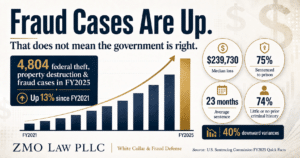
The U.S. Sentencing Commission just released its sentencing data on economic crimes, the FY2025 Quick Facts sheet on Theft, Property Destruction, and Fraud. It’s not exactly beach reading. But if you landed here because agents called, a subpoena arrived, your bank froze an account, or someone at work is suddenly using the word “fraud,” it may be worth paying attention to the numbers.
In fiscal year 2025, federal courts reported sentenced people in 66,662 criminal cases and the sentencing commission kept careful track of the data. Of those cases, 4,804 involved theft, property destruction, or fraud — a 13 percent increase since 2021. The median loss amount was $239,730. One in five cases involved losses of more than $1.5 million. Three-quarters of defendants went to prison, and the average sentence was 23 months. The courts where we practice, the Southern District of New York and Eastern District of New York, were both among the five busiest districts in the country for these prosecutions with more than 300 cases between them.
The phrase “theft, property destruction, and fraud” sounds like something from a filing cabinet, but the cases are not that tidy. They include forged checks, false billing, insurance claims, bank accounts, payroll, tax filings, Medicaid forms, business disputes, professional licensing issues, ad-tech schemes, and companies that collapsed and then got repurposed by prosecutors as crime scenes.
Most people charged in these cases are not career criminals. According to the Commission, 74 percent had little or no prior criminal history, and 52 percent received the “zero-point offender” adjustment, which can be a powerful tool to advocate for a lower sentence if you are a first-time offender.
That tracks with what we see. People charged with fraud are often small business owners, employees, immigrants, medical professionals, investors, or people who made bad decisions under pressure. Federal prosecutors are not in the business of grading people’s lives on a curve. They take messy facts and try to fit them into neat categories: conspiracy, wire fraud, bank fraud, healthcare fraud, Medicaid fraud, aggravated identity theft, aggravated identity theft, loss amounts and sentencing spreadsheets that rank people by “relative culpability.”
The spreadsheet can do enormous damage.
In fraud cases, the Sentencing Guidelines are often driven by “loss,” a powerful word that can mean actual loss, intended loss, reasonably foreseeable loss, loss connected to everyone in an alleged conspiracy, or a number negotiated by lawyers trying to end the case. The Commission reports that sentences were increased in 33 percent of cases based on victim or harm enhancements, 20 percent for sophisticated means, 15 percent for unauthorized identification, 16 percent for abuse of trust or special skill, and 11 percent for aggravating role. Each label can add months or years. Each can also be wrong.
ZMO Law PLLC has tried these cases across broad categories and is ready to try more as the government puts the fraud statutes to ever more novel uses.
In an SDNY trial, prosecutors accused our client of participating in a healthcare fraud scheme involving dental services and Medicaid billing. The case involved a foreign-educated dentist working without a New York dental license. The issue at trial was whether the government could prove the intent and knowledge required to turn unlicensed dental work into a felony fraud conviction.
Another case we tried involved a restaurant owner accused in a bank “bust out” scheme involving large numbers forged checks. Different world from the dental clinic, but it raised the same fundamental problem. The government built a simple story from complicated facts. Who knew what? Who touched which account? Who benefited? What did the documents actually show? What was proof of fraud, and what was just the government making a suspicious-looking leap?
Then there was the Aleksandr Zhukov trial in the Eastern District of New York, a digital advertising fraud case known as “Methbot.” The government described it as a sophisticated cyber fraud involving fake websites, spoofed domains, server farms, bots, and more than $7 million in alleged losses from ads supposedly never viewed by real human beings. A Department of Justice press release called it a major cybercrime conviction. WIRED later used the case to examine a larger and stranger online reality: the online advertising industry itself has long been riddled with fake traffic, murky incentives, and advertisers who do not want to look too closely at where their numbers come from — “everyone is fine with this.”
A cyber advertising case does not look much like a forged check case or a Medicaid billing case. But at trial, the defense questions are familiar: What did the client actually know? What did the customers know? What did the industry tolerate? What was hidden, and what was in plain view? Could the government prove intent to defraud beyond a reasonable doubt, or was it just translating a complicated market into a morality play?
At the other end of the white-collar spectrum, Zachary Margulis-Ohnuma previously represented people involved in the Martha Stewart trial, the Adelphia investigation, the Enron prosecution, and other significant white-collar criminal cases with clients including doctors, lawyers, accountants, and high-level corporate executives. Our federal criminal defense work starts from a simple routine: slow the case down, listen to the client, read the documents, get to know the witnesses, challenge the government’s adjectives, and prepare for trial even when a negotiated resolution may turn out to be the right answer.
One more number from the Commission deserves attention: 40 percent of theft and fraud sentences were downward “variances,” with an average reduction of 56 percent. That means that judge’s set aside the Guidelines and imposed sentences based on all the informatino before them. Sentencing judges (unlike Mr. Zhukov’s web traffic) are not robots. They often see that the Guidelines overstate culpability or miss the unique circumstances of the human being standing before them. Strong sentencing advocacy starts well before sentencing–when the subpoena arrives, when agents ask to “just clear things up,” when a prosecutor decides who is important and who is expendable.
If you are under investigation for fraud, bank fraud, healthcare fraud, forged checks, false billing, embezzlement, identity theft, tax issues, cyber fraud, or almost anything involving money and the federal government, do not try to talk your way out of it. More often than not, the result of opening your mouth without counsel is to give the government a statement to use against you.
Instead, call a lawyer who has tried fraud cases in federal court. ZMO Law represents clients in white-collar and fraud investigations in the Southern and Eastern Districts of New York and beyond. If the government has decided your work amounts to a fraud case, contact ZMO Law. We can help make sure the facts are not flattened into a sentencing chart. Past results do not guarantee future outcomes.